Learning to learn: how your brain retains information
Introduction
Organization is essential for anyone who wants to maintain a study routine. It is quite important to know the best way to study and retain knowledge.
Before showing the strategies to organize your studies, it is vital to understand the impacts of disorganization. Disorganization can lead to significant information loss, making it difficult to retain information effectively, resulting in inefficient cycle frustrations.
I have read some books and done some courses about techniques to optimize knowledge absorption, and I could understand how our brain works when we are learning something.
Get organized
I have read a book called “I have already understood” in Portuguese — Eu já Entendi, by Gladys Mariotto. The book talks about how we can organize our studies and teaches some techniques for our brain to retain information, and it describes the three processes that occur during the learning phase, which are:
-
Read: Reading provides the initial contact with the content, in any area and in any format;
-
Organize: Organizing the content is essential for defining better ways to structure your readings. You can use colorful summaries, index cards, or a combination of these and other methods;
-
Assimilate: Assimilating the content is the moment when our memory works to keep all the knowledge. The prior knowledge helps us when we need to retain information because it gives context and meaning to new ideas. When we connect new content with something we already know, it is easier for the brain to organize and store the information.
The learning pyramid
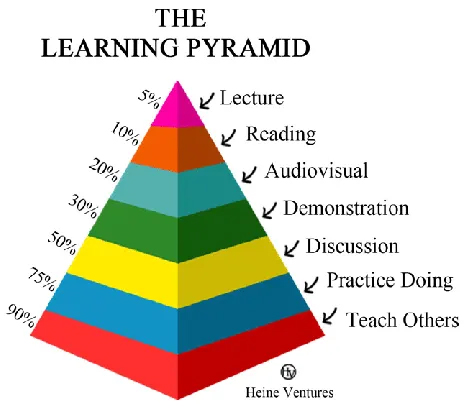
In the article Education Corner, by Becton Loveless, he talks about the concept of the learning pyramid. “The learning pyramid, sometimes referred to as the cone of learning, developed by the National Training Laboratory, suggests that most students only remember about 10% of what they read from textbooks, but retain nearly 90% of what they learn through teaching others.”.
The psychiatrist William Glasser (1925–2013) was a scientist and researcher, and he idealized the learning pyramid, a knowledge method in a schematic way, which explains how the human brain assimilates and stores information. Check the illustration below:
- 5% through lecture;
- 10% through reading;
- 20% through audiovisual;
- 30% through demonstration;
- 50% through discussing with others;
- 75% through doing;
- 90% through teaching someone.
As we can observe in the representation pyramid theory, we can retain a greater percentage of knowledge when we teach. Anyway, the best way to retain knowledge is by sharing. For example, we can teach someone about technical concepts about programming, while you teach, you memorize the content.